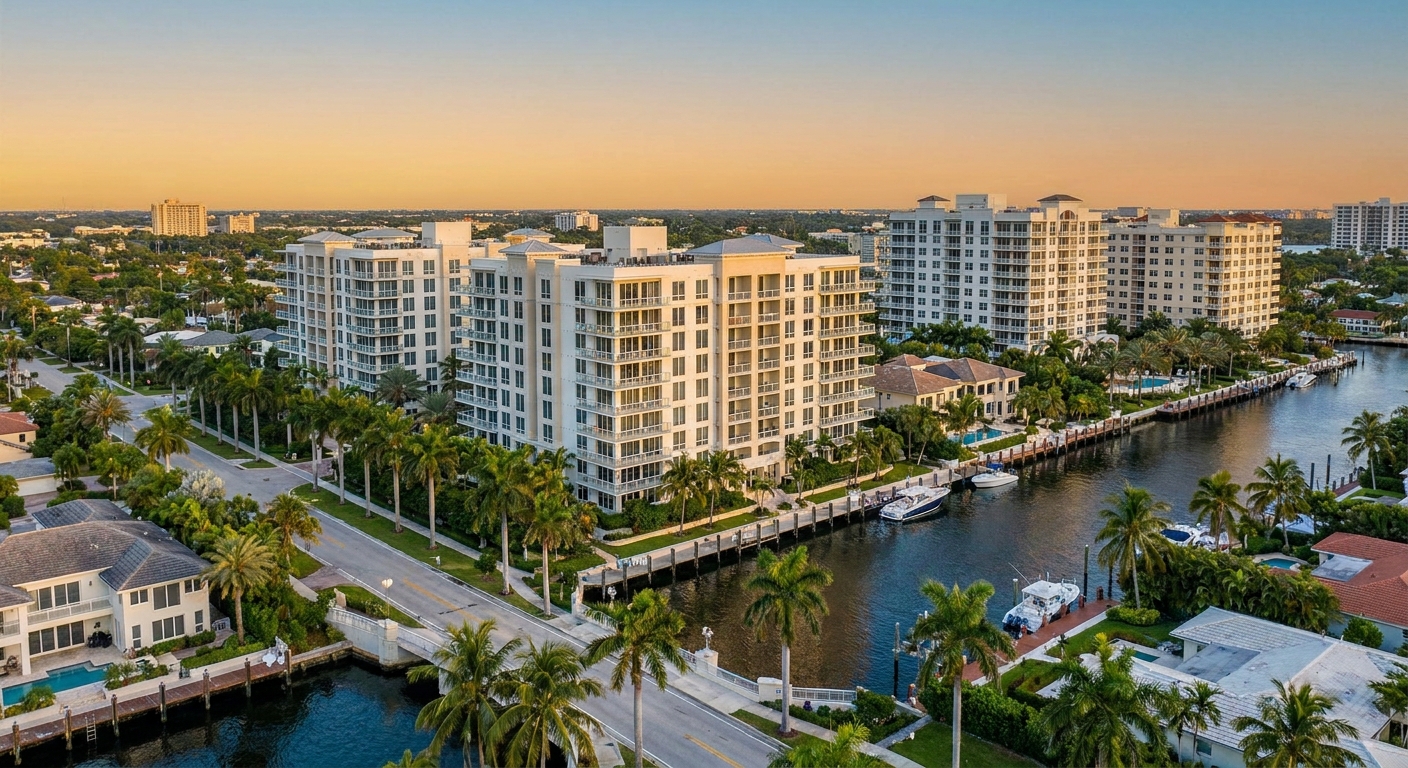
Fort Lauderdale 1031 Exchange Properties: 2026 Buyer Guide
Fort Lauderdale gives 1031 exchange investors one of the tightest windows in South Florida to redeploy capital into waterfront condos, multifamily buildings, and NNN retail before the IRS clock runs out — this guide breaks down what qualifies, what to prioritize, and where the deadlines actually bite in 2026.
- Fort Lauderdale 1031 exchange properties give investors 45 days to identify replacement assets and 180 days to close — miss either and the exchange fails.
- Waterfront multifamily near Las Olas is the safe pick for exchange buyers chasing cash flow and appreciation together: Buy.
- NNN retail along Federal Highway suits investors who want passive income with minimal management: Consider.
- Preconstruction condo units rarely close inside the 180-day window and should be Skipped for exchange purposes.
- Boutique short-term rental portfolios carry the highest management burden of the group: Consider only with a property manager lined up.
Why this matters
A failed 1031 exchange in Fort Lauderdale doesn't just cost you the tax deferral — it triggers immediate recognition of capital gains on the sale you already closed. The 45-day identification window and 180-day closing window run concurrently, not sequentially, which means an investor who spends three weeks touring properties has already burned two-thirds of their identification runway before making an offer.
Fort Lauderdale's inventory of qualifying replacement property looks different than Miami's. Less preconstruction speculation, more stabilized multifamily and retail with existing income streams — assets that actually close inside 180 days instead of sitting on a builder's delivery schedule. That distinction decides whether your exchange survives.
Who this is for
This guide is built for investors who've sold an appreciated property — a rental, a commercial building, raw land — and need to redeploy the proceeds into Fort Lauderdale real estate without triggering a taxable event. You're comparing asset classes under deadline pressure, not browsing listings for fun. You need property that closes fast, cash-flows on day one or shortly after, and doesn't introduce a debt structure that jeopardizes the exchange's equal-or-greater-value requirement.
What to look for in Fort Lauderdale 1031 exchange properties
Closing timeline certainty
A property that can't close inside 180 days isn't a 1031 candidate no matter how attractive the returns look on paper. Resale properties with clean title and no HOA litigation close in 30-45 days typically; preconstruction units routinely push past a year. For exchange buyers, the calendar outranks the finish-out.
Debt replacement math
To fully defer gains, your replacement property's debt must equal or exceed the debt you paid off on the relinquished property, unless you offset the shortfall with additional cash. This is the single most common mistake exchange investors make in Fort Lauderdale's cash-heavy waterfront market, where sellers often prefer buyers who can close without financing contingencies.
Income stability at acquisition
A property already generating rent at close reduces the pressure to "prove" the exchange's investment intent to the IRS. Vacant land or a gutted renovation project introduces risk that a stabilized multifamily building or leased retail strip doesn't carry.
Like-kind flexibility
Since 2018, like-kind treatment under Section 1031 applies only to real property, but that still covers a wide range — apartment buildings, retail centers, single-family rentals, even certain leasehold interests. Fort Lauderdale's mix of these asset types gives exchange investors more identification flexibility than a market dominated by one property type.
Exit liquidity for the next cycle
The property you buy today with exchange proceeds will eventually become the property you sell in your next exchange, or the one your heirs inherit at a stepped-up basis. Waterfront and transit-adjacent multifamily in Fort Lauderdale has historically shown deeper buyer pools at resale than isolated suburban product, which matters when you're planning a multi-decade deferral strategy.
Management complexity versus passive intent
Some exchange investors want a phone-off, mailbox-money asset. Others are comfortable running a small portfolio actively. Matching the property type to your actual appetite for management prevents the common regret of buying a 24-unit building and discovering you wanted a NNN lease instead.
Top picks for Fort Lauderdale 1031 exchange properties
Waterfront multifamily near Las Olas — the safe pick. Buildings in the 8-20 unit range along the New River and Intracoastal corridor typically close within 45-60 days when financing is pre-arranged, well inside the 180-day exchange window. Rental demand from young professionals working downtown keeps occupancy tight, and the asset class has shown resilience through multiple South Florida cycles. Verdict: Buy.
NNN retail along Federal Highway — the passive pick. Single-tenant retail with a corporate guarantor and 10+ years remaining on the lease requires almost no landlord involvement day to day. Cap rates on these assets move with interest rates, so timing your identification against rate announcements matters more here than in any other category on this list. Verdict: Consider.
Single-family rental portfolios in Wilton Manors and Oakland Park — the wildcard. Buying 3-5 individual homes instead of one building spreads risk across tenants and neighborhoods, but it also means coordinating multiple closings inside the same 180-day window — a logistical stress test most exchange investors underestimate. Verdict: Consider, with a closing team that's done simultaneous exchange closings before.
Boutique short-term rental portfolios near the beach — the high-touch pick. These assets can outperform traditional rentals on gross yield, but management intensity is real: nightly turnover, dynamic pricing, and local short-term rental ordinances that vary by municipality within Broward County. Verdict: Consider, only if a management company is contracted before you close.
Preconstruction condo units — the tempting mistake. Developer delivery schedules routinely slip past the 180-day exchange window, and a delayed certificate of occupancy can void the exchange entirely. Even units marketed as "near completion" in 2026 carry construction-delay risk that resale product doesn't. Verdict: Skip for exchange purposes specifically — these can still make sense as straight cash purchases.
Working through which of these categories fits your exchange timeline and debt profile is exactly the conversation Kelby Contreras' Fort Lauderdale advisory practice handles for out-of-state and international exchange buyers who can't run point on 45-day identification logistics themselves.
What to avoid
- Land banking as a "replacement property." Raw land qualifies as like-kind, but it produces no income, which makes it harder to defend the investment-intent requirement if the IRS ever questions the exchange.
- Properties under active HOA or condo association litigation. Title companies flag these late in the process, sometimes inside your final closing window, which can blow the 180-day deadline entirely.
- Any deal requiring seller financing contingent on approval timelines you don't control. Exchange closings need certainty; seller-financed deals introduce a second party's underwriting risk into your already-compressed calendar.
Verdict comparison
| Property Type | Closing Certainty | Debt Replacement Fit | Management Load | Verdict |
|---|---|---|---|---|
| Waterfront multifamily (Las Olas) | High | Strong | Moderate | Buy |
| NNN retail (Federal Highway) | High | Strong | Low | Consider |
| Single-family rental portfolio | Moderate | Flexible | Moderate-High | Consider |
| Short-term rental portfolio | Moderate | Flexible | High | Consider |
| Preconstruction condo | Low | Weak | Low | Skip |
FAQ
What qualifies as a Fort Lauderdale 1031 exchange property?
Any real property held for investment or business use qualifies as like-kind under Section 1031, including multifamily buildings, retail centers, and single-family rentals in Fort Lauderdale. Personal residences and property held primarily for resale, like fix-and-flip inventory, do not qualify.
How long do I have to identify a replacement property?
You have 45 calendar days from the closing of your relinquished property to formally identify replacement candidates in writing. This deadline does not extend for weekends, holidays, or slow-moving negotiations.
How long do I have to close on the replacement property?
You have 180 days total from the sale of the relinquished property, running concurrently with the 45-day identification period, not after it. Preconstruction and litigation-encumbered properties are the most common reasons investors miss this deadline.
Is preconstruction condo a good 1031 exchange property in Fort Lauderdale?
Generally no, because developer delivery timelines routinely exceed the 180-day closing window required for a valid exchange. Resale multifamily or retail with immediate closing availability is the safer exchange vehicle.
Can I do a 1031 exchange into multiple Fort Lauderdale properties?
Yes, you can identify and acquire multiple replacement properties as long as their combined value meets or exceeds the relinquished property's value. This is common with single-family rental portfolios but requires coordinated closings within the 180-day deadline.
What happens if my 1031 exchange fails?
A failed exchange triggers immediate recognition of the capital gains tax on your original sale, typically at the 20% federal long-term rate plus applicable depreciation recapture. This is why closing timeline certainty is the top criterion for selecting replacement property.
Do I need a qualified intermediary for a Fort Lauderdale 1031 exchange?
Yes, IRS rules require a qualified intermediary to hold the sale proceeds between the relinquished and replacement property closings. You cannot take direct receipt of the funds at any point without disqualifying the exchange.
What Fort Lauderdale neighborhoods work best for exchange investors?
Las Olas-adjacent multifamily and Federal Highway retail corridors offer the closing speed and income stability exchange investors need in 2026. Both areas have deeper resale buyer pools than isolated suburban product, which matters for your next exchange down the line.
One last thing
Most exchange investors lose their 45-day window not from a lack of good properties, but from spending the first two weeks deciding what they even want — by the time they call an agent, a third of the runway is gone. Line up your replacement-property criteria and a closing team before you ever list the relinquished asset, not after.
“The 45-day clock doesn't care how good the next deal looks if you spent three weeks deciding what you wanted.”


