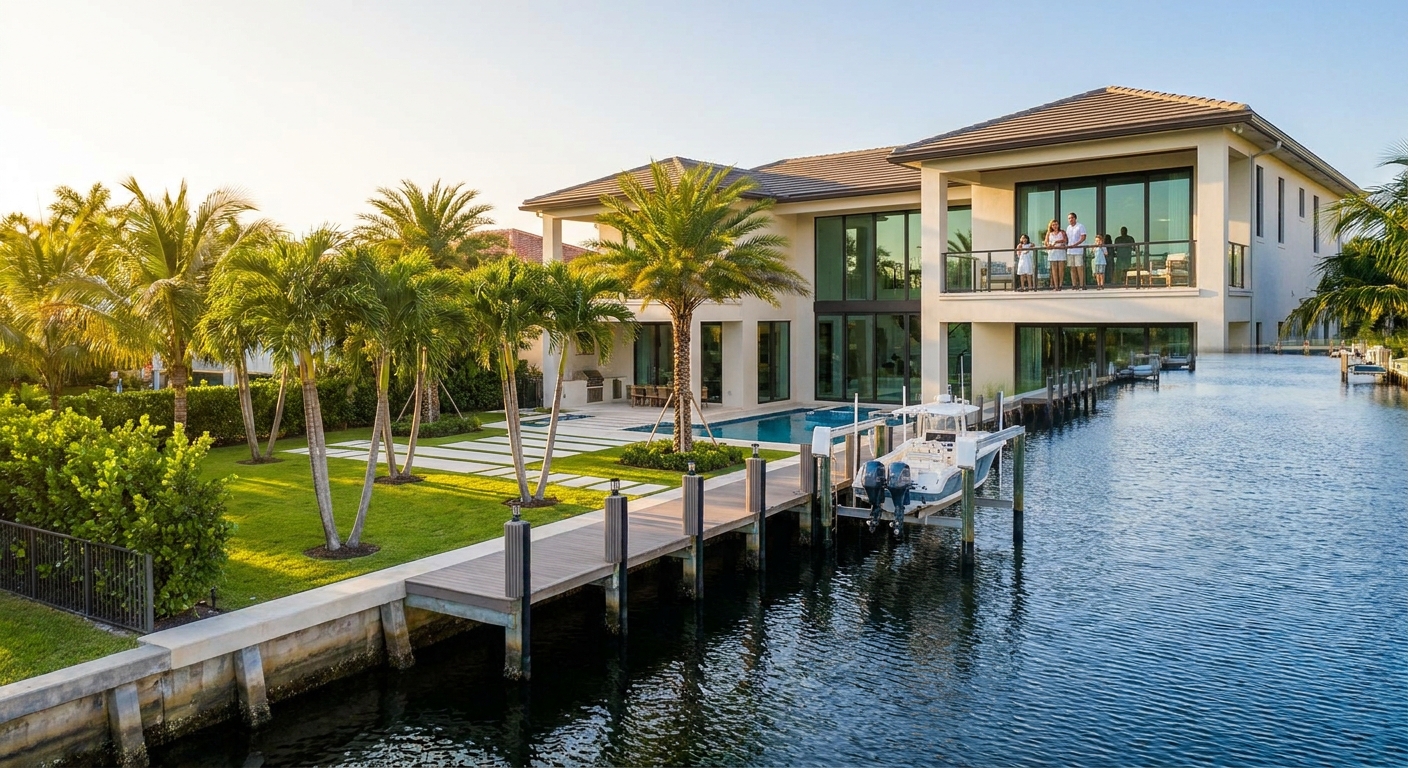
How to Choose a Waterfront Home in Fort Lauderdale 2026
Fort Lauderdale's waterfront market splits into three distinct products — ocean-access canal lots, no-fixed-bridge deepwater estates, and intracoastal frontage with limited clearance — and picking the wrong category costs buyers six figures in insurance, dock retrofits, and resale friction. This guide walks through the exact sequence Kelby Contreras uses to vet a waterfront home in Fort Lauderdale before an offer goes in.
- Choosing a waterfront home in Fort Lauderdale starts with fixed-bridge clearance, not square footage, in 2026.
- Seawalls older than 25-30 years often need replacement at $600-$1,200 per linear foot.
- Flood Zone AE properties run 20-40% higher insurance premiums than Zone X in 2026.
- Boaters must verify dock depth at low tide; under 5 feet limits vessel size significantly.
Why this matters
Fort Lauderdale holds roughly 300 miles of navigable waterway, which is why the city earned the "Venice of America" label decades ago. That geography means two homes on the same street can sit in completely different flood zones, face opposite dockage rules, and carry insurance quotes $8,000 apart.
Buyers who skip verifying bridge height, seawall condition, and flood designation often find out after closing that their vessel doesn't clear the bridge or their premium doubled. Kelby Contreras filters every waterfront search on three variables most buyers never think to ask about: dockage access, seawall age, and FEMA flood zone — because in 2026, each one moves price and insurability independently of the listing's finished square footage.
What you'll need
- A marine and seawall survey scheduled during due diligence, not after
- A flood insurance quote in hand before you write an offer
- Vessel dimensions on file if you own or plan to buy a boat: length, beam, draft, and air draft
- A title search confirming submerged land rights and permitted dock work
- 45-60 days of closing runway when a seawall or dock contingency is involved
The steps
1. Define your access requirement before touring anything
Decide upfront whether you need ocean access with no fixed bridges, a canal home behind one or more bridges, or pure intracoastal frontage with a view but limited navigation. This single decision eliminates 60-70% of listings on any given search and keeps you from falling for a home that photographs well but doesn't function for your use case. Review current inventory on Fort Lauderdale waterfront listings before setting your criteria in stone.
Common mistake: touring intracoastal-view homes when the buyer actually wants to dock a 45-foot sportfish boat with no bridge restrictions.
2. Confirm fixed bridge height and depth if you own a boat
If you own or plan to buy a vessel, pull the bridge clearance charts for every bridge between the home and open water. Air draft — mast height on a sailboat — trips up more buyers than boat length ever does. A property that looks perfect on paper becomes unusable if your vessel can't clear a 15-foot fixed bridge at high tide. The waterfront homes for boaters in Fort Lauderdale guide breaks down which corridors run no-fixed-bridge to open water.
Expected outcome: a shortlist narrowed to only the canals your vessel can actually navigate.
3. Order a seawall and dock inspection before writing an offer
Seawalls older than 25-30 years frequently need replacement, and South Florida contractors quote $600 to $1,200 per linear foot for that work in 2026. A 100-foot seawall in poor condition can mean a $60,000-$120,000 line item that never shows up in the listing photos. Get the inspection scheduled during your due diligence window, not as an afterthought.
Common mistake: relying on the seller's disclosure alone instead of an independent marine inspection.
4. Pull the FEMA flood zone map and get a real insurance quote
Zone AE properties run 20-40% higher premiums than Zone X in 2026, and that gap can shift your monthly carrying cost by hundreds of dollars. Request a quote from at least two carriers before you finalize your offer price — insurance cost belongs in your negotiation math, not a post-closing surprise.
Expected outcome: a real monthly carrying-cost number you can compare across competing properties.
5. Verify legal dockage rights and any HOA restrictions
Some waterfront parcels include deeded dock rights; others lease dock space or restrict vessel size and liveaboard status through an HOA or condo association. Read the governing documents before you fall in love with the water view. The how to buy waterfront property in Florida guide covers the legal distinctions between deeded, leased, and shared dockage in more depth.
Common mistake: assuming dock access transfers automatically with the home sale.
6. Run comparables on price per waterfront foot, not just price per square foot
Waterfront lots in Fort Lauderdale price on linear seawall footage as much as living area — figure $3,000 to $8,000 per linear foot depending on corridor and bridge access in 2026. A smaller home on 100 feet of prime no-fixed-bridge seawall can outprice a larger home on a restricted canal.
Expected outcome: a comp set that actually reflects waterfront value, not just interior finishes.
7. Negotiate with waterfront-specific contingencies
Build your offer around a marine survey contingency, seawall certification, and confirmation that any existing dock work carries proper permits. Generic home inspection contingencies don't cover what's underwater.
Common mistake: using a standard residential contract with no marine-specific language.
8. Close with a title review confirming submerged land rights
Confirm the title includes rights to the submerged land under the dock and that no unpermitted seawall or dock modifications exist in county records. Unpermitted work can delay closing or trigger a forced remediation after you own the property.
Expected outcome: a clean title with documented dock permits and no open code violations.
Considering Fort Lauderdale waterfront?
Get curated, dockage-verified listings matched to your vessel and access needs.
Troubleshooting
- Fixed bridge too low for your vessel — target no-fixed-bridge lots only; retrofitting a boat around a bridge isn't realistic.
- Seawall cracked or leaning — negotiate a repair credit against the $600-$1,200 per linear foot replacement estimate before closing.
- Flood insurance quote higher than expected — request an elevation certificate; homes built above base flood elevation often qualify for lower premiums.
- HOA restricts boat size or liveaboard status — read the dock rules in full before writing an offer, not after you're under contract.
- Title shows unpermitted dock work — require the seller to obtain retroactive permits or credit the cost of remediation.
“If your seawall inspection report is older than five years, treat it as expired.”
Tools and resources
- Marine surveyor with seawall certification experience
- FEMA flood map service for current zone designation
- County records search for dock permits and code violations
- Independent insurance quotes from at least two carriers
- A buyer's guide covering waterfront homes for sale in Miami, if you're comparing markets side by side
What to do next
Once you've narrowed a shortlist, run the property tax exposure and consider whether a 1031 exchange makes sense if you're selling another investment property to fund the purchase. Both decisions affect your net cost more than most buyers expect, and both should be modeled before you're under contract, not after.
FAQ
What's the best area for waterfront homes in Fort Lauderdale?
No-fixed-bridge canals off the New River and Las Olas Isles corridor command the highest premiums for boaters in 2026, while intracoastal-view homes cost less but offer no direct ocean access. The right area depends entirely on whether you own a vessel and what it needs to clear.
Is ocean-access property better than intracoastal for resale?
Ocean-access, no-fixed-bridge property historically resells faster and at a premium because the buyer pool includes serious boaters, not just view buyers. Intracoastal frontage still holds value but competes on view alone.
How much does a seawall replacement cost in Fort Lauderdale?
Seawall replacement runs $600 to $1,200 per linear foot in 2026, so a 100-foot seawall in poor condition can mean $60,000 to $120,000 in near-term cost. Get an independent marine inspection before you finalize an offer.
How do I know if my boat fits under the bridges?
Pull the official bridge clearance charts for every fixed bridge between the property and open water, checking air draft against mast height at high tide. Sailboat owners get caught by this more often than powerboat owners.
What flood zone is most of Fort Lauderdale waterfront in?
Much of the waterfront corridor sits in Zone AE, which carries 20-40% higher insurance premiums than Zone X in 2026. Elevation certificates can reduce that gap for homes built above base flood elevation.
How much does flood insurance cost on a waterfront home in 2026?
Cost varies by zone, elevation, and coverage amount, but Zone AE properties run meaningfully higher than Zone X comparable homes. Get quotes from at least two carriers before writing an offer so the number is locked in, not estimated.
Do I need a marine survey before buying waterfront property?
Yes — a standard home inspection doesn't cover seawall condition, dock structural integrity, or submerged utilities. A marine survey during due diligence catches issues that can cost tens of thousands after closing.
Can foreign buyers purchase waterfront homes in Fort Lauderdale?
Foreign buyers can purchase Fort Lauderdale waterfront property with no citizenship restriction, though financing terms and title structuring differ from domestic purchases. Work through the legal and tax implications before you make an offer.
One last thing
The detail most buyers overlook: dock depth at low tide, not high tide. A canal that reads deep enough on a Tuesday afternoon tour can leave 18 inches of clearance at low water, which grounds a deep-draft vessel twice a month. Ask for a low-tide depth reading before you commit, not after you've moved the boat in.


