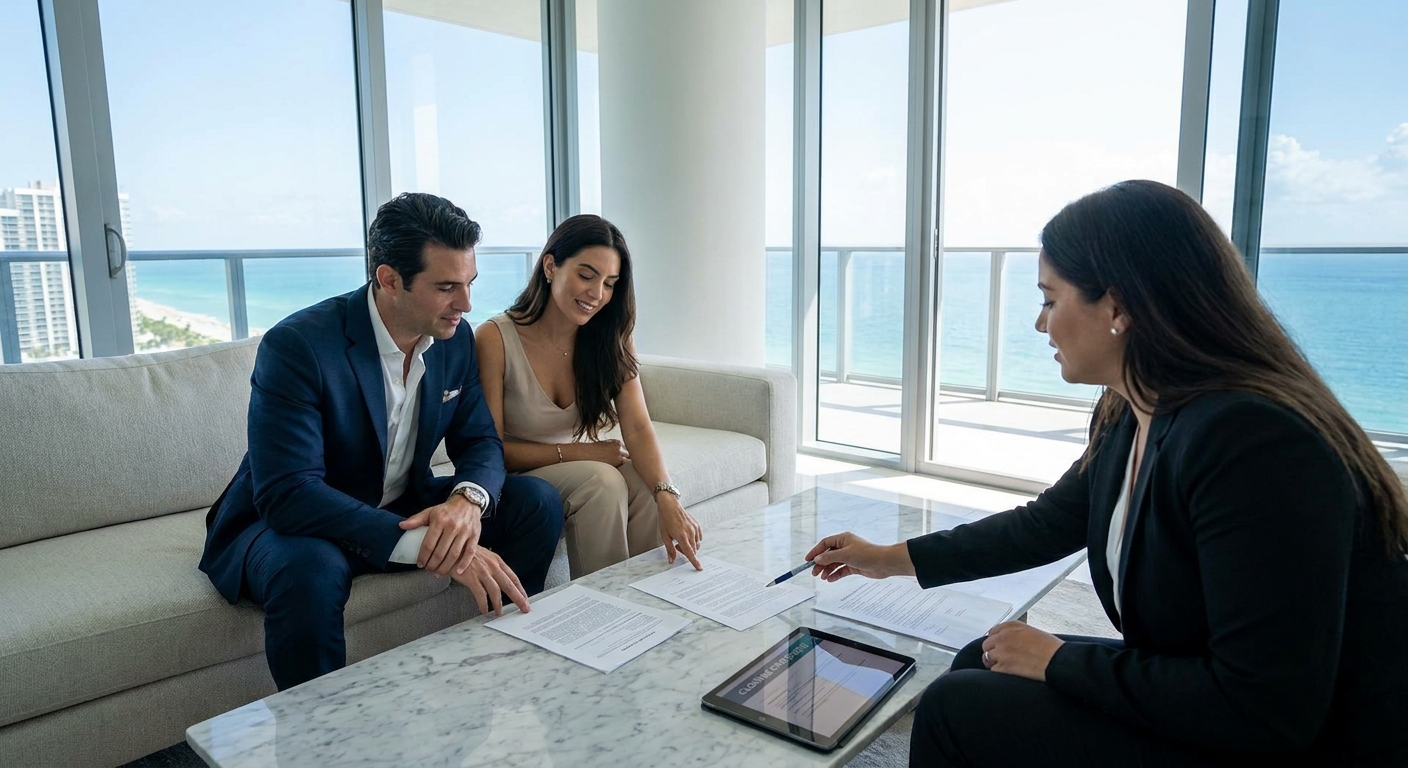
Negotiate Closing Costs on a Luxury Condo in Miami (2026)
Closing costs on a luxury condo in Miami run 2% to 5% of the purchase price for buyers and can climb higher for sellers once transfer taxes and commissions are factored in — and nearly every line item on that settlement statement has room to move if you know which ones to press.
- Closing costs on a luxury condo in Miami typically run 2%-5% of purchase price for buyers in 2026.
- Seller credits toward closing costs are easier to win than price reductions when a unit has sat 60+ days.
- Miami-Dade's documentary stamp tax is $0.60 per $100 of sales price, separate from title insurance and lender fees.
- Preconstruction condo buyers should push developers on title company assignment before signing, not after.
- Kelby Contreras negotiates seller concessions as a line-item strategy, not a single lump discount request.
Why this matters
A generic 3% closing cost estimate on a $500,000 condo is an inconvenience. On a $3 million oceanfront unit in Sunny Isles Beach or Brickell, that same 3% is $90,000 — money that either stays in your pocket or gets negotiated away before you sign.
Most buyers treat the closing disclosure as fixed. It isn't. Title insurance, settlement fees, and even developer-side charges on preconstruction condos carry more flexibility than agents let on, especially in a 2026 market where days-on-market for units above $2 million have stretched past the pace seen in 2022 and 2023.
What you'll need
- A copy of the estimated closing disclosure from your lender or title company
- The listing history and days-on-market for the specific luxury condo unit
- A licensed Florida title company willing to itemize fees (not bundle them)
- Your financing pre-approval letter, since concessions often hinge on loan terms
- An agent who will negotiate credits, not just price — this is where Kelby Contreras earns the fee
The steps
1. Audit the closing cost estimate line by line
Pull the loan estimate or cash closing statement and separate it into three buckets: government fees (doc stamps, recording), lender fees (origination, underwriting), and third-party fees (title insurance, survey, HOA estoppel). Government fees are fixed by statute. The other two are not.
Miami-Dade's documentary stamp tax on the deed is $0.60 per $100 of sales price — on a $2.5 million condo, that's $15,000, and it's non-negotiable regardless of who pays it. Everything else on the sheet is a target.
Common mistake: accepting the title company the listing agent recommends without asking if you can shop it. Florida law lets the buyer choose the title company in most transactions.
2. Time your negotiation to leverage market conditions
A unit that's been listed 90+ days has a seller who's already recalculated their net proceeds mentally. That's your opening. Ask your agent to pull the property's days-on-market and any prior price changes before you draft an offer.
In 2026, inventory of luxury condos priced above $1.5 million in Miami-Dade and Broward has sat longer than in the two prior years, which shifts negotiating leverage toward buyers on non-trophy units. Waterfront and branded residences in prime buildings still move fast and give sellers less reason to concede.
Expected outcome: a seller credit of 1%-2% toward closing costs is realistic on slower-moving inventory; trophy units rarely offer more than a token concession.
3. Ask for a seller credit instead of a price cut
Sellers resist lowering the sale price because it resets the comp for the building. They're far more open to crediting $20,000-$50,000 toward your closing costs at the closing table, because that number never shows up in the public sales record the same way.
Structure the offer so the credit is capped at what your lender allows — conventional loans typically cap seller concessions around 3% of purchase price, jumbo loans vary by lender. Confirm the cap with your loan officer before you submit the number.
Buy this approach over a straight price reduction when the seller has resale-comp concerns for the building.
4. Negotiate title insurance and settlement fees separately
Title insurance premiums in Florida are set by a promulgated rate — $5.75 per $1,000 of coverage up to $100,000, with declining rates above that threshold — so the premium itself isn't negotiable. The settlement fee, search fee, and closing agent fee charged on top of it are.
Get a quote from at least one independent title company outside the developer's or listing agent's preferred vendor. A $1,200 discrepancy in settlement fees between two Miami title companies on the same $2 million condo is common enough to be worth the phone call.
5. Push back on developer or association fees for preconstruction and resale
Preconstruction buyers face developer-controlled closing costs, including a mandatory title company assignment in most contracts and a capital contribution to the condo association, often 1-3 months of maintenance fees collected upfront. Ask whether that contribution is negotiable before you sign the purchase agreement, not after.
Resale buyers face estoppel fees — the charge for the condo association to certify the unit's financial standing — which typically run $250-$500 in Florida but can run higher for expedited turnaround. Ask the seller to absorb the estoppel fee; it's a small ask sellers rarely refuse.
6. Use your financing contingency as leverage
A buyer with a firm pre-approval and a short financing contingency window is a lower-risk closing for the seller — use that to ask for a credit in exchange for waiving inspection contingencies on cosmetic items, not structural ones. Never waive a milestone or structural inspection on a luxury condo to win a closing cost concession.
Common mistake: waiving too much contingency protection to chase a $10,000 credit on a $2 million purchase. The math rarely favors that trade.
7. Get every concession in writing in the amended contract
Verbal agreements about closing cost credits mean nothing at the closing table. Every negotiated item — seller credit amount, estoppel fee responsibility, title company selection — needs to appear in a signed addendum before the closing disclosure is finalized.
Expected outcome: a final closing disclosure that matches what you negotiated, with zero surprise line items at signing.
Negotiate your Miami condo closing costs
Get a line-item review of your estimated closing disclosure before you sign.
Troubleshooting
- Seller refuses any credit toward closing costs. Shift the ask to a repair credit or personal property inclusion (furniture, parking space) instead — sellers often say yes to a concession framed differently than the same dollar amount as a closing credit.
- Lender caps the seller concession below what you negotiated. Ask the seller to apply the excess to a rate buydown or prepaid HOA dues instead of a cash credit at closing.
- The condo association estoppel fee is listed as non-negotiable by the management company. It usually is fixed by the association's own fee schedule — negotiate who pays it, not the amount.
- Developer says the title company assignment in a preconstruction contract can't change. Ask for a credit equal to the difference between the developer's title fee and an independent quote instead of fighting the assignment itself.
- You're a foreign buyer confused about FIRPTA withholding. FIRPTA can require 15% of the gross sales price withheld at closing on the seller's side — this affects seller net proceeds and can make them more willing to negotiate other line items, but it's a seller-side issue, not a buyer closing cost.
Tools and resources
- Property taxes on luxury homes in Miami — understand the ongoing carrying cost tied to your purchase price
- Miami luxury condos for sale — current inventory to benchmark days-on-market before you negotiate
- A licensed Florida title company for an independent settlement fee quote
- Your lender's loan estimate, updated within the last 10 days before closing
What to do next
If you're still shopping preconstruction inventory, read the guide to buying a preconstruction condo in Florida before you sign a reservation agreement — developer closing cost structures get locked in earlier than most buyers realize.
FAQ
What are typical closing costs on a luxury condo in Miami in 2026?
Buyer closing costs on a luxury condo in Miami run 2% to 5% of the purchase price in 2026, covering title insurance, lender fees, doc stamps, and prepaid escrow. On a $3 million unit that's $60,000 to $150,000 before any negotiated credits.
Who pays closing costs in Florida, buyer or seller?
Both sides pay separate closing costs in Florida — sellers typically cover the real estate commission and the deed's documentary stamp tax, while buyers cover title insurance, lender fees, and recording costs. Either side can negotiate credits toward the other's costs.
Can you negotiate seller concessions on a luxury condo in Miami?
Yes, seller concessions toward closing costs are negotiable, especially on units listed 60 or more days. Concessions are typically capped at 2-3% of purchase price by the buyer's lender, so confirm the cap before negotiating a number.
What is the Miami-Dade documentary stamp tax rate?
Miami-Dade County charges $0.60 per $100 of sales price in documentary stamp tax on the deed, lower than the $0.70 per $100 rate used in most other Florida counties. This tax is fixed by statute and not negotiable.
Are closing costs different for preconstruction condos in Miami?
Yes, preconstruction condos add a capital contribution to the condo association, often 1-3 months of maintenance fees, and developers frequently require using their assigned title company. Both terms are set in the purchase contract before you close.
How much is title insurance on a $2 million condo in Florida?
Florida's promulgated title insurance rate is $5.75 per $1,000 of coverage up to $100,000, with declining rates above that threshold, putting a $2 million policy in the range of roughly $10,000 to $11,000. The premium itself is set by state rate, though settlement fees on top of it vary by title company.
Does FIRPTA withholding apply to foreign buyers of Miami condos?
FIRPTA withholding applies to the seller, not the buyer, when the seller is a foreign person — it can require 15% of the gross sales price withheld at closing. Foreign buyers should still budget for standard closing costs separately from any FIRPTA discussion.
When is the best time to negotiate closing costs in Miami?
The best leverage comes when a unit has been on the market 60 to 90 days or more, since sellers become more open to credits than price cuts at that point. Trophy waterfront and branded residence units in prime buildings rarely offer the same room to negotiate.
One last thing
Most buyers negotiate the sale price and stop there — the closing disclosure gets treated as a formality. The line item with the most room to move in 2026 isn't the price at all, it's the settlement fee bundled into title services, which can swing by over a thousand dollars between two Miami title companies quoting the same condo.


