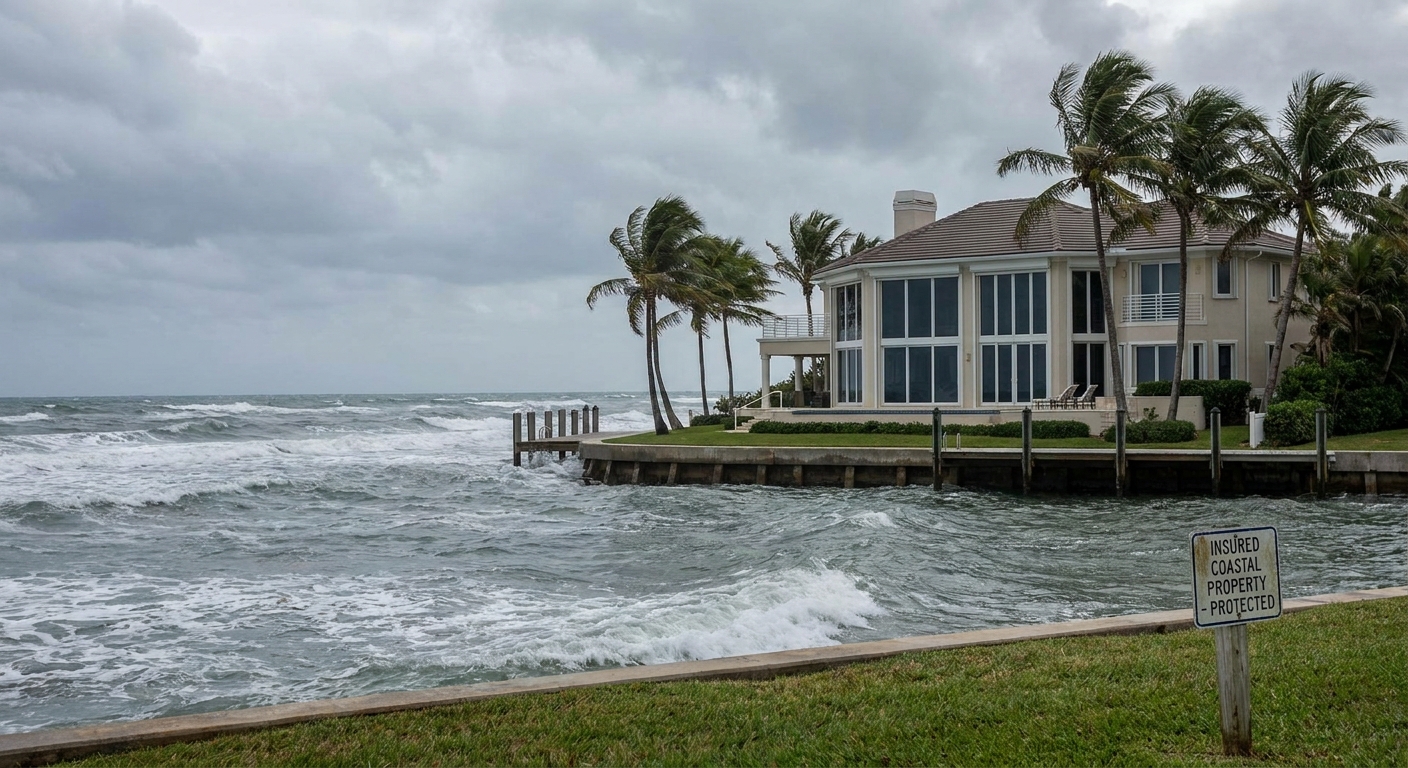
Insure a Waterfront Home vs Hurricanes in Florida 2026
Insuring a waterfront home in Florida in 2026 means stacking three separate policies — wind, flood, and often a surplus-lines wrap — because no single carrier covers storm surge, wind damage, and contents under one roof anymore.
- You need separate wind and flood policies to insure waterfront home hurricanes florida coverage properly, since NFIP caps out at $250,000 on the dwelling.
- An elevation certificate and a wind mitigation inspection are the two documents that move your premium the most in 2026.
- Hurricane deductibles run 2% to 10% of dwelling coverage, so know the dollar figure before you sign, not just the percentage.
- Luxury waterfront homes over $1M in rebuild cost usually need excess flood and a surplus-lines wind policy layered on top of NFIP limits.
Why this matters
Florida's coastal insurance market tightened hard after the 2022 and 2023 hurricane seasons, and by 2026 most waterfront buyers are underwriting insurance costs before they underwrite the mortgage. A property that looks like a steal on price per square foot can carry a five-figure annual premium once wind, flood, and excess coverage are stacked, and lenders won't close without proof of both. Kelby Contreras walks buyers through this stack before an offer goes in, because the insurance quote often reshapes the negotiation more than the appraisal does.
For context on what actually holds up in a storm, the hurricane-resistant construction standards covered in this guide matter as much to your premium as your zip code.
What you'll need
- An elevation certificate — required for any home in a flood zone built before the current base flood elevation maps, usually $400-$700 from a licensed surveyor
- A four-point inspection — roof, electrical, plumbing, HVAC; most private carriers won't quote a home over 15 years old without one
- A wind mitigation inspection — documents roof shape, roof-to-wall connections, opening protection; this is the single biggest lever on premium
- Your CLUE report — the insurance claims history tied to the property, pulled before you write an offer
- Rebuild cost estimate, not market value — insurers price to reconstruction cost, and waterfront homes often cost more to rebuild than they'd sell for
- 30-45 days before closing to shop wind, flood, and excess coverage separately
The steps
1. Pull the elevation certificate first
Every flood premium in Florida is built off the base flood elevation (BFE) shown on the FEMA flood map versus the lowest floor of the structure. A home built two feet above BFE can pay a third of what an identical home at BFE pays. Order this before you shop rates, because without it insurers quote worst-case and you overpay by default. Common mistake: buyers assume flood zone X means no flood insurance is needed; lenders on waterfront property in Miami, Fort Lauderdale, or Palm Beach almost always require it anyway.
2. Run the wind mitigation inspection
This $75-$150 inspection documents hip roofs, secondary water barriers, roof-to-wall clips versus straps, and impact-rated openings. Florida's Office of Insurance Regulation requires carriers to apply mitigation credits, and a home with impact windows and a reinforced roof-to-wall connection can see wind premiums drop 20% to 45% versus an unmitigated home of the same value. Skipping this step means paying full freight for coverage the house may already qualify to discount.
3. Separate your flood policy from your windstorm policy
Standard Florida homeowners policies exclude flood and storm surge entirely, so you need a distinct flood policy, either through the NFIP or a private flood carrier. NFIP caps out at $250,000 on the dwelling and $100,000 on contents, which doesn't come close to covering a $2M waterfront estate. Verdict on relying on NFIP alone for luxury waterfront: Skip. Layer in excess flood coverage from a private market carrier to close the gap.
4. Insure to rebuild cost, not purchase price
A 4,500-square-foot waterfront home on Las Olas or in Manalapan can cost $450-$650 per square foot to reconstruct in 2026 given labor and material costs along the coast, often more than the purchase price if land value is a large share of the deal. Underinsuring the dwelling means a coinsurance penalty at claim time, where the carrier pays a reduced percentage of any loss. Get a contractor-grade rebuild estimate, not a Zillow number.
5. Choose your hurricane deductible deliberately
Florida policies carry a separate hurricane deductible, expressed as a percentage of dwelling coverage, typically 2%, 5%, or 10%. On a $1.5M dwelling limit, a 5% hurricane deductible means the first $75,000 of storm damage comes out of pocket before the policy pays a dollar. Buyers chasing a lower monthly premium often pick 10% without doing this math. Common mistake: treating the deductible percentage as an abstract number instead of converting it to dollars against your specific dwelling limit.
6. Compare Citizens against private and surplus-lines carriers
Citizens Property Insurance remains the insurer of last resort for many coastal Florida properties, but its coverage caps by county mean high-value waterfront homes frequently need a surplus-lines carrier; names like Lloyd's and Lexington show up often on luxury waterfront quotes. Private admitted carriers such as Universal, Heritage, and Slide have re-entered parts of the coastal market in 2025 and 2026 with more competitive terms for well-mitigated homes. Get at least three quotes; pricing spreads of 30%+ between carriers on the same risk are common in 2026.
7. Layer excess flood and umbrella coverage
Once NFIP or private flood coverage tops out, an excess flood policy fills the gap up to full rebuild value, and a personal umbrella policy adds liability protection dock owners and pool owners specifically need. This layering is standard practice on waterfront estates over $1M and rarely optional once a lender's insurance requirement kicks in.
8. Re-shop every renewal, not just at purchase
Roof age, updated wind mitigation credits, and shifting carrier appetite mean the best policy at closing is rarely the best policy three years later. Review coverage annually, especially once a roof crosses the 10-year mark, since several carriers require a new roof inspection or reduce coverage automatically at 15 years.
Get insurance guidance before you offer
Kelby Contreras coordinates elevation certificates and carrier introductions for waterfront buyers.
Troubleshooting
- Roof is over 15 years old and carriers won't quote — get a roof certification from a licensed contractor confirming remaining useful life; some carriers will still write coverage with a documented 5+ year lifespan.
- Dwelling value exceeds Citizens' county cap — move to a surplus-lines or admitted private carrier that specializes in high-value coastal homes; standard retail agents may not carry these appointments.
- Flood zone VE surcharge is unexpectedly high — VE zones (high-velocity wave action) carry the steepest flood premiums; confirm the exact zone on the FEMA map before you assume AE pricing applies.
- Mortgage servicer force-places insurance mid-escrow — this happens when proof of flood or wind coverage lapses even briefly; keep renewal dates synced and confirm your agent sent binder confirmation to the lender directly.
- Claim gets disputed as wind versus flood damage — hurricanes often cause both simultaneously, and carriers sometimes shift blame between wind and flood policies; photograph damage immediately and get an independent adjuster if the split looks unfair.
- Condo master policy leaves a gap on your unit — confirm what the building's master policy covers versus what you need on an HO-6 policy (interior finishes, contents, loss assessment).
Tools and resources
- FEMA Flood Map Service Center for current base flood elevation data
- Florida Office of Insurance Regulation's wind mitigation credit schedule
- A licensed four-point and wind mitigation inspector (ask your agent for a referral list)
- How to buy waterfront property in Florida for the full purchase sequence insurance fits into
- How to choose a waterfront home in Fort Lauderdale for elevation and construction factors that affect both resale and premiums
What to do next
If you're still comparing neighborhoods before the insurance conversation even starts, the waterfront homes for sale in Miami buyer's guide walks through how flood zones and construction age vary block by block across the market.
FAQ
How much does it cost to insure a waterfront home in Florida in 2026?
Waterfront homes in Florida typically run $8,000 to $25,000 a year combining wind and flood coverage in 2026, with luxury properties over $2M often exceeding that once excess flood and umbrella coverage are added. Mitigation credits and roof age move this number significantly in either direction.
Is Citizens Property Insurance enough for a waterfront home?
Citizens works for many mid-market coastal properties but caps coverage by county, so high-value waterfront estates often need a private or surplus-lines carrier to reach full rebuild value. Check your county's Citizens cap before assuming it covers the full dwelling limit.
Do I need flood insurance if my waterfront home isn't in a high-risk flood zone?
Yes, in most cases, because lenders on waterfront property in Miami, Fort Lauderdale, and Palm Beach typically require flood insurance regardless of the FEMA zone designation. Storm surge doesn't respect zone boundaries during major hurricanes.
What is a hurricane deductible and how is it different from a regular deductible?
A hurricane deductible is a separate percentage-based deductible, usually 2% to 10% of the dwelling coverage limit, that applies only to hurricane-related wind damage. On a $1M dwelling limit, a 5% hurricane deductible means $50,000 comes out of pocket before the policy pays.
Does impact glass actually lower insurance premiums?
Yes. Impact-rated windows and doors qualify for wind mitigation credits that can cut wind premiums 20% to 45% depending on the carrier and the rest of the home's mitigation features. The credit applies at every renewal, not just at purchase.
Can I get insurance on an older waterfront home with an original roof?
It depends on the roof's remaining useful life, and many carriers require a four-point inspection and won't write new coverage on roofs over 15-20 years old without a certified inspection confirming condition. A roof replacement often unlocks better rates even before the age cutoff.
What's the difference between NFIP flood insurance and excess flood insurance?
NFIP flood insurance caps at $250,000 on the dwelling and $100,000 on contents, which rarely covers a luxury waterfront home's full rebuild cost. Excess flood insurance from a private carrier fills the gap between the NFIP cap and the home's actual value.
Should I insure a waterfront home before or after making an offer?
Get a preliminary insurance quote before finalizing an offer, since premiums on waterfront property can shift the real monthly cost enough to change the negotiation. A 30-45 day insurance contingency gives enough time to shop wind, flood, and excess coverage properly.
One last thing
The wind mitigation inspection is the cheapest move on this entire list relative to its payoff. A $100 inspection can unlock a 20-45% discount that repeats every year the home is owned, which over a decade dwarfs almost any other insurance decision on the list.


