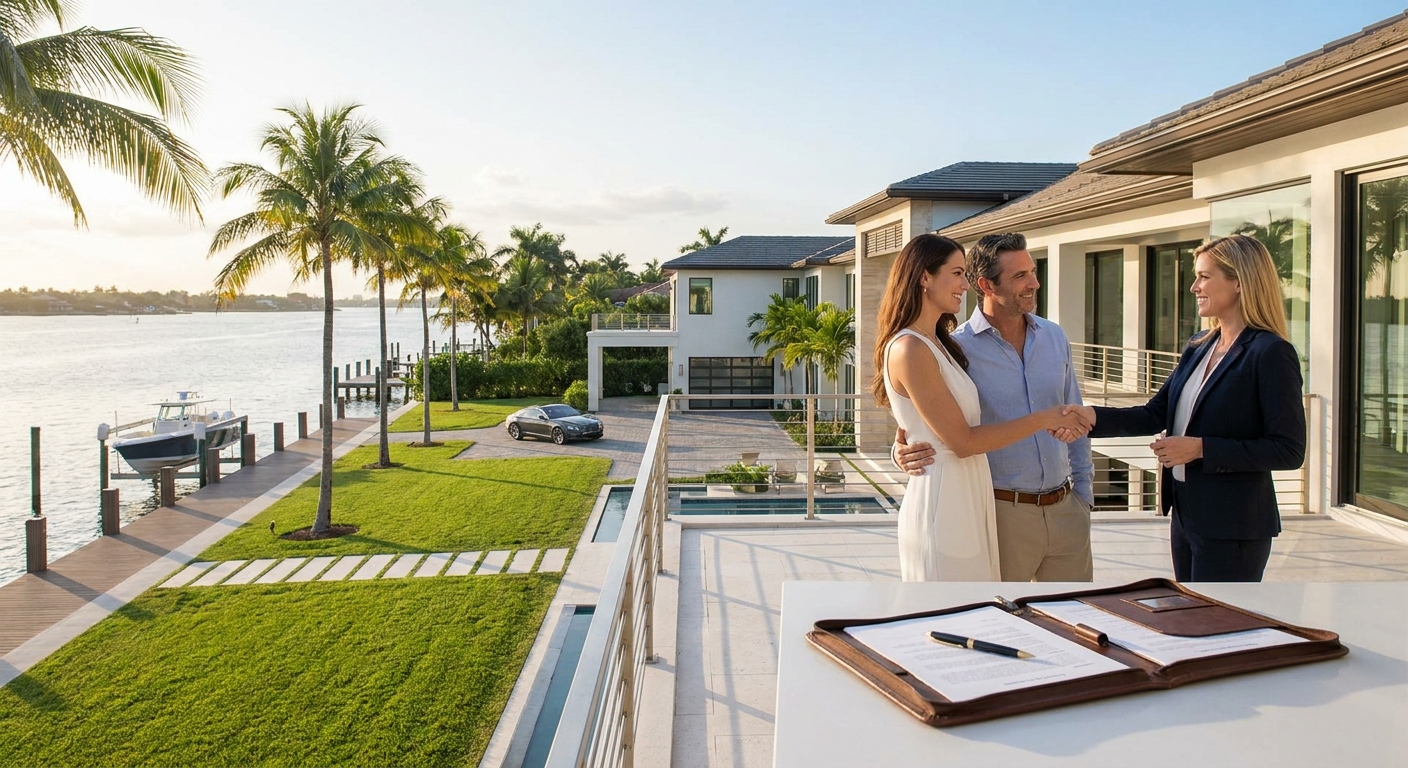
Buy a Luxury Home All-Cash in Florida: 2026 Step Guide
Buying a luxury home with an all-cash offer in Florida in 2026 means proving liquidity fast, structuring the deal to skip financing contingencies, and closing in a fraction of the time a mortgaged buyer needs. Here's the exact sequence to do it right in Miami, Fort Lauderdale, or Palm Beach.
- Sellers in South Florida's 2026 luxury market favor all-cash offers because they close in 10-21 days versus 30-45 for financed deals.
- Proof of funds from a bank or brokerage statement is the single document that makes or breaks a cash offer — get it before you tour a home.
- Skipping the appraisal contingency saves negotiating leverage but only makes sense when comparable sales support your price.
- Wire fraud, not financing, is the biggest risk on a cash deal — verify wire instructions by phone every time.
Why this matters
Cash is leverage in a market where inventory at the $2 million-plus tier moves fast and sellers get nervous about financing falling through in the final week. An all-cash offer removes the lender's appraisal timeline, the underwriting review, and the loan contingency that lets a financed buyer walk. Sellers in Palm Beach and Fort Lauderdale routinely take a lower cash offer over a higher financed one because certainty is worth more than a few extra points.
Kelby Contreras structures cash offers for buyers moving on waterfront estates, preconstruction condos, and investment properties across Miami, Fort Lauderdale, and Palm Beach, and the pattern holds in 2026: the buyer who shows proof of funds on day one closes faster and negotiates from strength. Financed buyers still dominate volume, but at the luxury tier, cash wins the multiple-offer situation almost every time.
What you'll need
- Proof of funds letter from your bank, brokerage, or fund administrator — dated within 30 days
- Entity documentation if you're buying through an LLC, trust, or holding company (operating agreement, EIN, formation docs)
- Wire transfer instructions verified directly with the title company by phone, never by email alone
- A title company or closing attorney experienced with cash luxury transactions in Florida
- A buyer's agent who can pull comparable sales and negotiate the contingency structure
- Insurance quotes in hand before you write the offer — hurricane coverage on coastal property in 2026 can run into five figures annually and affects your real net cost
If you're weighing a waterfront purchase specifically, review how to buy waterfront property in Florida before you start touring — flood zone and seawall condition change the cash math on coastal estates.
The steps
1. Verify and document your funds
A proof of funds letter is non-negotiable in 2026's luxury market — listing agents will not forward your offer to the seller without one. Get a letter from your bank or brokerage showing liquid assets equal to or greater than the purchase price, dated within the last 30 days. Common mistake: submitting a screenshot of an account balance instead of an official letter on institutional letterhead — sellers' attorneys reject these outright.
2. Decide how you're taking title
Buying through an LLC or trust protects privacy and can simplify estate planning, but it adds a documentation step every closing attorney will ask for. Decide this before you make an offer, not during due diligence — switching entities mid-contract delays closing by a week or more. Foreign buyers in particular benefit from setting up the holding structure first; if that's you, the process for investing in Florida real estate as a foreign buyer covers entity and tax mechanics specific to non-resident purchasers.
3. Structure the offer to maximize your cash advantage
Write the offer with a shortened inspection period — 7 to 10 days instead of the standard 15 — and either waive or shorten the appraisal contingency since you're not relying on a lender's valuation. This is the single biggest reason sellers accept cash offers below asking: certainty and speed replace top-dollar pricing. Common mistake: waiving the inspection contingency entirely to look aggressive — you still need to know what you're buying, especially on older waterfront properties with seawalls and dock infrastructure.
4. Put down real earnest money
Earnest money on a cash luxury deal typically runs 5% to 10% of purchase price, higher than the 1% to 3% common on financed deals, because it signals you're serious and gives the seller recourse if you default. On a $3 million property, that's $150,000 to $300,000 held in escrow. Skimping here weakens your negotiating position immediately.
5. Skip the loan contingency, keep the inspection
The loan contingency is the clause you're eliminating — that's the entire point of an all-cash offer, and it's what shaves 20 to 30 days off a typical closing timeline. Keep the inspection and title contingencies intact; they protect you from problems financing has nothing to do with, like liens or structural issues. If your budget flexes and you're weighing financing anyway, compare terms against how to get a jumbo mortgage for a luxury home in Florida before you commit fully to cash — sometimes a blended structure with a small loan preserves liquidity for renovation or a second property.
6. Order title work and wire verification immediately
Cash deals move fast, which means title search and wire setup need to start the day the contract is signed, not the week before closing. Confirm wire instructions with your title company by phone using a number you already had on file, never one from an email. Wire fraud targeting cash real estate closings is the most common way buyers lose six-figure sums in a single transaction — a five-minute phone call prevents it.
7. Negotiate closing costs and credits
Cash buyers still owe title insurance, transfer taxes, and recording fees, and there's room to negotiate who pays what, especially in a slower-moving submarket. Sellers sitting on a property for 90-plus days in 2026 are more willing to cover a portion of closing costs or offer a credit toward property tax proration. The mechanics for doing this on a condo purchase are laid out in how to negotiate closing costs on a luxury condo in Miami, and the same leverage points apply to single-family estates.
8. Close and record
A clean cash closing on a Florida luxury property takes 10 to 21 days from contract execution, compared to 30 to 45 for a financed deal. Review the settlement statement line by line before you wire final funds, and confirm the deed records within 24 to 48 hours after closing. Common mistake: assuming a fast closing means less scrutiny — read every page of the closing package regardless of timeline.
Ready to structure your cash offer?
Get a strategy session on your all-cash purchase before you make an offer.
Troubleshooting
The seller's agent doubts your proof of funds is current. Request a bank officer's direct confirmation or a signed letter dated within the past two weeks — older letters get discounted in a market where liquidity can shift fast.
Your entity documentation is delaying the contract. Get your LLC or trust paperwork finalized before you start touring homes, not after you're under contract — this is the single most common cause of cash-deal delays in 2026.
A competing financed offer comes in higher. Emphasize your shortened timeline and reduced contingencies in writing to the listing agent — many sellers will take a cash offer 3% to 5% below a financed one for the certainty.
Title comes back with an unexpected lien. Don't rush this to protect your fast-close timeline — resolve it in writing with an extension, even a short one, rather than closing with an open title issue.
Insurance quotes come back higher than expected on coastal property. Get quotes before you're under contract, not during due diligence, especially for properties needing wind mitigation upgrades — the guide on insuring a waterfront home against hurricanes in Florida breaks down what drives premiums up in 2026.
Your wire gets flagged or delayed by your bank. Large international or same-day wires often trigger compliance holds — notify your bank of the pending wire 48 hours in advance to avoid a closing-day scramble.
Tools and resources
- A title company or real estate attorney with cash luxury closing experience in your target county
- A buyer's agent who can pull comps and structure contingencies — Kelby Contreras works directly with cash buyers across Miami, Fort Lauderdale, and Palm Beach
- Property tax estimates before you offer — see property taxes on luxury homes in Miami for how millage rates and homestead exemptions affect your carrying cost
- Insurance quotes from at least two carriers specializing in coastal and waterfront risk
- A wire verification protocol agreed with your title company in writing before the day of closing
What to do next
If this cash purchase is part of a larger portfolio move — selling one investment property to fund the next — look at how to do a 1031 exchange in Florida before you close. Timing a 1031 exchange against a cash purchase changes your identification and closing deadlines, and it's far easier to plan for than to retrofit after the fact.
FAQ
Do you need proof of funds to make an all-cash offer in Florida?
Yes, sellers and their agents require a proof of funds letter dated within 30 days before they'll forward a cash offer for consideration. A bank statement screenshot is not sufficient — it needs to be an official letter on institutional letterhead.
How much faster does a cash offer close compared to a financed offer?
A cash closing on a Florida luxury property typically takes 10 to 21 days, compared to 30 to 45 days for a financed deal. The difference comes from skipping the loan underwriting and lender-ordered appraisal.
Is an all-cash offer always accepted over a financed offer?
Not always, but sellers frequently accept a cash offer 3% to 5% below a competing financed offer because it removes financing risk entirely. In multiple-offer situations at the luxury tier, cash wins more often than not.
How much earnest money is needed for a cash luxury home purchase in Florida?
Earnest money on a cash deal typically runs 5% to 10% of the purchase price, higher than the 1% to 3% standard on financed deals. On a $3 million property that's $150,000 to $300,000 held in escrow.
Should you buy a luxury home in Florida through an LLC or in your own name?
An LLC or trust adds privacy and estate planning benefits but requires documentation the closing attorney needs before contract, not during due diligence. Foreign buyers in particular should set this up before making offers.
What's the biggest risk in an all-cash Florida real estate closing?
Wire fraud is the most common way cash buyers lose money — fraudulent wire instructions sent by email can redirect six-figure sums instantly. Always verify wire details by phone using a number you already had on file.
Can you waive the inspection contingency on a cash offer?
You can, but it's not advisable on older waterfront properties with seawalls or dock infrastructure that need evaluation regardless of financing. Waiving the appraisal contingency is more common and lower-risk since you're not relying on a lender's valuation.
Do cash buyers still pay closing costs in Florida?
Yes, cash buyers still owe title insurance, transfer taxes, and recording fees even without a loan. There's room to negotiate seller credits toward these costs, especially on properties that have been on the market 90-plus days.
One last thing
The part most cash buyers overlook in 2026 isn't the offer — it's the insurance quote. A waterfront property that looks like a clean cash deal on paper can carry a five-figure annual premium once wind mitigation and flood zone factors are priced in, and that number should shape your offer before you sign, not after.


